
۱۲ بهمن ۱۴۰۴

Chitosan extracted from the Persian Gulf chiton shells: Induction of apoptosis in liver cancer cell line
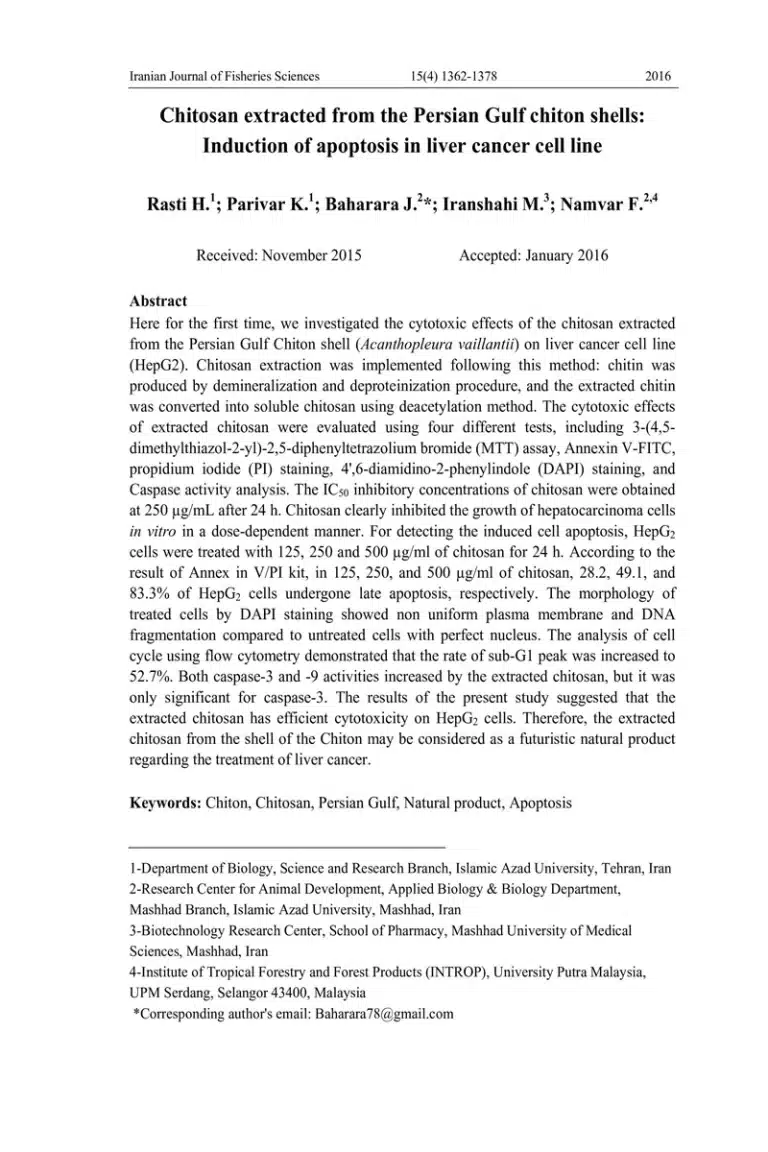
Here for the first time, we investigated the cytotoxic effects of the chitosan extracted
from the Persian Gulf Chiton shell (Acanthopleura vaillantii) on liver cancer cell line
(HepG2). Chitosan extraction was implemented following this method: chitin was
produced by demineralization and deproteinization procedure, and the extracted chitin
was converted into soluble chitosan using deacetylation method. The cytotoxic effects
of extracted chitosan were evaluated using four different tests, including 3-(4,5-
dimethylthiazol-2-yl)-2,5-diphenyltetrazolium bromide (MTT) assay, Annexin V-FITC,
propidium iodide (PI) staining, 4',6-diamidino-2-phenylindole (DAPI) staining, and
Caspase activity analysis. The IC50 inhibitory concentrations of chitosan were obtained
at 250 µg/mL after 24 h. Chitosan clearly inhibited the growth of hepatocarcinoma cells
in vitro in a dose-dependent manner. For detecting the induced cell apoptosis, HepG2
cells were treated with 125, 250 and 500 µg/ml of chitosan for 24 h. According to the
result of Annex in V/PI kit, in 125, 250, and 500 µg/ml of chitosan, 28.2, 49.1, and
83.3% of HepG2 cells undergone late apoptosis, respectively. The morphology of
treated cells by DAPI staining showed non uniform plasma membrane and DNA
fragmentation compared to untreated cells with perfect nucleus. The analysis of cell
cycle using flow cytometry demonstrated that the rate of sub-G1 peak was increased to
52.7%. Both caspase-3 and -9 activities increased by the extracted chitosan, but it was
only significant for caspase-3. The results of the present study suggested that the
extracted chitosan has efficient cytotoxicity on HepG2 cells. Therefore, the extracted
chitosan from the shell of the Chiton may be considered as a futuristic natural product
regarding the treatment of liver cancer